
EDITION: CLASS.
Palm Oil is a bracing and consistently engaging book. However, the pressure to ascribe agency to palm oil, and all the consumer goods in which it’s an ingredient, can lead to some eyebrow-raising claims.
The palm oil industry traces its roots directly back to the transatlantic trade in enslaved people, and to the colonisation that followed European capitalists’ realisation that it remained lucrative, and was less bad for PR at ‘home’, to simply seize the products of African labour.1 Palm oil is still harvested by poorly-treated workers who are still paid incredibly little by global standards, on plantations that have been in place since the colonial era, and which keep expanding in the wake of fires that raze the planet’s last remaining old-growth forests. It’s used in everything from food to fuel and cosmetics, and it’s a product of untold suffering and destruction. It’s also extremely profitable.
In the Global North, palm oil has come to popular attention largely due to the campaigning work of environmental groups like Greenpeace. In his book Palm Oil: The Grease of Empire (Pluto Press, 2022), Max Haiven observes:
Since at least trace amounts of palm oil are in a huge variety of products used by consumers on a daily basis it offers environmental campaigners, many of whom work for organisations that depend on donations, a tempting point of contact with the general public. (p.77)
If it’s “a tempting point of contact” for campaigners, it has also provided rich terrain for authors; a growing number of whom have, in recent years, attempted to name and challenge their readers’ palm oil consumption by publishing troubling, expansive histories of this commodity and its production.
First came Jocelyn C. Zuckerman’s Planet Palm, a sweeping journalistic account of (to crib from the subtitle) ‘How Palm Oil Ended Up in Everything – and Endangered the World’. Then there was Jonathan E. Robins’ centuries-spanning Oil Palm: A Global History, which tracks the palm from its earliest cultivation and uses in Sub-Saharan Africa, through its agonising relationship with the slave trade and colonialism, to its present status as the source of an international commodity used by billions of people every day—whether they know it or not. Sophie Chao’s In the Shadow of the Palms, published in June 2022, offers a posthumanist perspective on the industrial cultivation of oil palms. There’s even literature on the topic for children: James Sellick and Frann Preston-Gannon’s There’s a Rang-Tan In My Bedroom (2019). A spin-off of an animated video produced by Greenpeace (and re-used by the supermarket Iceland in a marketing campaign run by the questionable2 PR agency Weber Shandwick), this book tells the story of an orangutan who breaks into a little girl’s house and “keeps shouting OOO! at her [palm oil-containing] shampoo and chocolate,” and offers “information about orangutans and palm oil plus exciting ideas about how young readers can make a difference.”
Many of these palm oil books could be roughly classed as ‘material histories’ – a term used by Alexander Luckmann in a review of two recent books about asphalt and sand. Luckmann attributes the current boom in material history books to a “growing discomfort with the structure of extraction and consumption that underlies our world.” Writers publishing in this broad category have set themselves the task of increasing readers’ discomfort about, variously, concrete, wood, brick, flax, guano, twine, and rubber. Despite Marx’s own well-documented and much-discussed interest in materials such as guano, books that focus on particular raw materials or commodities are not inevitably Marxist, or even necessarily ‘progressive’, in their politics. As Jason W. Moore has argued, accounts that attribute “historical powers” to substances or commodities are fundamentally at odds with Marx’s materialist method, which stresses the historically-specific contexts and labour processes through which these ‘things’ (in their historically varied manifestations) were produced. At another level, books on these products can always be artfully angled away from the worst of the suffering and destruction on which their production depends, aiming instead to instil in the reader an appreciative or overawed kind of mindfulness, where global supply chains are understood as conveyor belts of cleverly-organised Christmas elves uniting to produce our consumer goods. Roland Ennos’ The Wood Age (‘“Stunning” – John Carey) can’t be faulted for celebrating the ingenuity of humans (and, for a charmingly large part of its opening chapter, orangutans) in the uses we make of trees and timber. But, perhaps surprisingly for a book by a biologist who’s spent so much time in the forests of Borneo, the word “deforestation” mainly crops up as part of the phrase “deforestation myths”, and Ennos has nothing to say about land grabs or forced evictions of forest peoples.3 Likewise, while Chris Miller’s Chip War (‘“Indispensable” - Niall Ferguson’) does address the international labour arbitrage that led to the concentration of microchip production in East Asian factories, the book’s protagonists aren’t labour and capital – they’re the US, China, and the companies that produce the chips through “a triumph of efficiency”.4 But the social and environmental violence of the palm oil industry is now so widely acknowledged that any honest engagement with it must reckon with the ugliest aspects of Actually Existing Capitalism.
None of the palm oil books (those aimed at adults, at least) shy away from this. Planet Palm – which opens with an epigraph from Frantz Fanon’s The Wretched of the Earth – freely acknowledges that the Communist Party of Indonesia (PKI) were almost solely responsible for attempts “to enact land reform and to improve wages and living conditions for the country’s plantation workers” in the 1950s and 60s.5 Those attempts (and the PKI itself) were, of course, ultimately crushed in a CIA-backed coup, which involved what even the CIA themselves acknowledge as “one of the worst mass murders of the 20th century”. Robins’ Oil Palm is so detailed and comprehensive that it seems likely to be used almost as a reference book, but it boils with descriptions of the rankest exploitation and the most brave and inspiring revolts (many of which were led by women, and provide fascinating examples of Luddite sabotage against technological ‘innovations’ that would undermine workers’ bargaining power), and at one point cites Moore’s Capitalism in the Web of Life.
For all of this, Haiven’s Palm Oil: The Grease of Empire is the most explicitly radical of the crop, both in its analysis and in the solutions that it proposes—it ends with a call for revolution. Weighing in at just under 120 pages, Palm Oil provides a fluent summary of the existing material (both Zuckerman’s and Robins’ books are acknowledged warmly in the opening chapter; Chao’s came out a few months after Haiven’s), as well as covering aspects of palm oil’s history and usage that the other books do not. Its main distinction, however, lies in its lively, and sometimes provocative, engagement with theory. This can sometimes feel a little jarring in a text framed explicitly as a ‘pamphlet’, where space and scope might not allow for the sufficient unfolding of concepts. Some of the posthumanist questions posed in the opening chapter are phrased a little obliquely; for example:
what does it mean to be human in a world made of oil palm, in the sense that it is in or on or part of the production of so many things we use every day? What does it mean to tell our story to ourselves in bodies that are made of palm oil, in the sense that we, all of us, metabolise it from our food or wear it on our skin? (p.10)
Mean for what? For whom? In what sense? This may be my failing as a reader, but I struggled to parse what either of these questions really ‘mean’, or to grasp what answers to them might look like. Overall, though, the book is written in an engaging style, and its arguments and political commitments are clear.
The central thrust of the argument is that capitalism depends on a “vast, globe-spanning system of mystified human sacrifice” (p.1). It describes how “that three-faced god: capitalist accumulation, white supremacist ideology, and inter-imperialist rivalry”(p.8) establishes a system in which particular groups of people and places are rendered ‘cheap’ or ‘surplus’, and therefore marked for sacrifice (in the form of life-sapping labour, disease and violent death). This system of sacrifice is “mystified” in the sense that its sacrificial character is naturalised, made invisible by the dominant ideology of capitalist individualism and homo economicus. These ideological constructs are described as “fetishistic” in character. Here, the term is used in both a Marx-ish and a Freudian sense, to mean something that obscures, or makes us forget, a traumatic secret – in this case the destructive, sacrificial nature of the system in which we spend—and end—our lives.
Developing its reading of Marx’s account of commodity fetishism, the book argues that every commodity can act as “a holographic shard” of this “greater capitalist totality”, through which it’s possible to perceive
all the extended socioeconomic relations on which [the processes of exploitation that were invested in each stage of its production] depend: the processes that produced the food that fed those workers, the exploitation of women in the home that reproduced those workers’ labour power, the relations of direct or subcontracted violence and coercion that made each step of the process possible. (p.37)
If commodity fetishism is (in this reading) a way of ‘unseeing’ the true material relations and systems of exploitation that loom behind each commodity, the book attempts to use palm oil as a prism through which readers can re-see. In this sense Haiven can be seen to be strategically deploying fetishism against itself, so that, pushed to its extremes, the “social hieroglyphic (as Marx describes the product transformed by value) can be deciphered. The apparent hope is that by re-seeing the true face of this sacrificial system, “the entangled world of exploitation from which [palm oil] emerged and of which each consumer is a part” (p.42), ‘we’ can start to form a new collective transnational identity that isn’t separated into atoms and hierarchies, good consumers and producers vs. surplus flesh for the sacrificial altar, and instead build a new world based on equality and cooperation.
So, in a way, Palm Oil isn’t really about palm oil. Or rather, it is, but only insofar as an examination of the palm oil industry serves to reveal a deeper truth about the capitalist system. Unlike some of the other palm oil books, which take the reader on what are essentially historical plantation tours, this bigger systemic picture is not glimpsed incidentally, in the background of real events. Here, the system itself is what we’re touring, and palm oil is the pair of holographic specs that we are given to wear by the tour guide: a lens through which we can see, and understand, a whole structure.
Taken on these terms, the book is extremely effective. Its arguments are sincere, its targets are well-chosen, and it both brings together and brings to life the ideas of a stimulating range of other writers (Michael Taussig, Anna Tsing, Jacques Rancière, Silvia Federici, Georges Bataille and Ruth Gilmore Wilson, to name only a few), in prose that’s accessible and often stirring. The following points of criticism, then, should be taken as attempts to think with the text, and not against it.
As the summary above indicates, the book refers to a number of concepts from Marx and the Marxist tradition, and builds its arguments on definitions of those concepts. So, while it doesn’t present itself explicitly as an intervention in Marxological debates, it wouldn’t be unfair to assess it in terms of how it deploys those concepts. And the way it frames the concept of commodity fetishism is worth dwelling on here, because it is illustrative of several recurring problems.
The book introduces the concept as follows:
…soap represented a profoundly “fetishised” object. For Karl Marx, who doubtless saw such advertisements almost daily, as well as the squalor of working-class life near his home in London’s Soho, commodity fetishism was ultimately a process of forgetting. It describes the way we come to see certain commodities as almost magical. Soap, for instance, was sold as a kind of talisman to ward off the evils and risks of late Victorian society… But for Marx, fetishism was also a much more common and subtle process, whereby the fetishised object appears to us as if from nowhere, detached from the socioeconomic processes that produced it… In the Marxist sense, these commodities were taken for the magical means by which the gears of propriety, cleanliness, normative gender, racial coherence, and social position were lubricated in the imperial capitalist machine. (pp.41-3)
The first thing to say about this relates to the accuracy and verifiability of historical claims. Haiven’s suggestion – that seeing ads for products like soap could have influenced Marx’s writing about how capitalism makes consumers ‘fetishise’ certain products they buy – is beguiling. But it is also totally speculative and historically doubtful, as attested by the same sources cited in the book. In this case, the cited work is Anne McClintock’s Imperial Leather, which states that “before 1851, advertising scarcely existed.” This date is relevant because Marx’s writing on the commodity fetish dates back to the early 1840s. Imperial Leather goes on to state that “the first wrapped soap was sold under a brand name” in 1884 and that “this small event signified a major transformation in capitalism…”6 This date, too, is relevant, because Marx died in 1883. For these reasons of basic chronology (as well as others we’ll get into shortly), it’s highly unlikely there was any link between Marx’s writing on the commodity fetish and advertisements for soap. But even if the dates lined up, in the absence of anything like a reference to such advertising in Marx’s writing, the fact that two things occurred around the same time does nothing to demonstrate that they’ve got anything to do with each other. This Marx-soap correlation is a minor, passing comment in the book – nothing depends on it – but it’s one of a number of instances of speculative links and suggestions which seem to have been included for no particular benefit other than to create an overall impression of connectedness, if not the overawed, totalising effect that other ‘material history’ books often aim for. In these instances, what may be intended as a literary approach veers close to the kind of pattern-recognition methodology found in conspiracy theory.
Another problem with the quoted passage relates to its description of fetishism, and its implications for the book’s overall argument. The precise meaning of Marx’s writing on the fetish character of commodities is conceptually slippery, and is a subject of extensive debate and disagreement. But Palm Oil’s reading of Marx is anachronistic. A different reading can help us tease out some implications of the book’s overall approach.
Marx writes that the fetish “attaches itself to the products of labour, as soon as they are produced as commodities, and is therefore inseparable from the production of commodities.” Every commodity has a fetish character, simply by virtue of being a commodity – a thing with an exchange-value. It doesn’t acquire its fetish character through the outlandish claims made about it in ad campaigns. Through the mediating process of commodity exchange, a real social relation between people is impressed on the commodity, and comes to seem like a natural feature of it.7 As Michael Heinrich and I.I. Rubin each emphasise in their accounts of the commodity fetish, it’s not just a subjective invention.8 If it was, then simply pointing out the underlying reality would be sufficient for the fetish to collapse like a witch’s glamour. This distinction may seem more or less important depending on how invested the reader is in what Marx really meant. But even if the concept of the fetish is creatively expanded beyond its original use in Marx’s work, the question of whether fetish is mere illusion – created at will by capitalists to deceive consumers – has a direct bearing on what is to be done. After painting a vivid portrait of the violence and devastation wrought by the capitalist system, the main solution the book proposes to those of us in the Global North is for us to ‘see through’ the fetish, shatter these conscious illusions about commodities and the systems of exploitation and sacrifice they depend on, imagine ourselves anew as fellow-humans, and thus escape the current system. This seems less satisfactory if the fetish is understood differently; not as an illusion, but as an expression of what Heinrich calls “an actual situation”.9 What if we see ourselves as separate and divided less through an illusory veil of ignorance than through a fetishised perception of the real divisions that characterise contemporary imperialism, as described by John Smith and Intan Suwandi?10 What if these problems can’t be overcome just by interpreting the world correctly, but only by taking more tangible actions to change it?
A final point to make about this passage relates to perspective – to adapt the book’s own visual metaphor. Despite the book describing itself as a corrective to this tendency, its emphasis on consumer perception (and illusion) in the passage relating to commodity fetishism is just one example of a repeated return to the perspective of the consumer, and therefore of a missed opportunity to help the reader to ‘see’ from the perspective of capital. In Marx, the fetish isn’t only a feature of the consumer’s apprehension of commodities, but also of the capitalist’s, and the bourgeois economist’s. Even if we allow that Palm Oil is more of a broadly anti-capitalist book than a strictly Marxist one, the question of what makes capitalism distinct from – for example – feudal plunder is sometimes left obscure, or implied to be a difference simply of scale and technological advancement. We’ll return to this point when considering the book’s account of British capitalists’ ‘use’ of the palm oil extracted from colonised West Africa.
Haiven’s choice of approach puts palm oil under a lot of pressure. For it to work as a “holographic shard” revealing capitalism’s sacrificial totality, it needs to have a tangible relevance to all of the facets of capitalism that the book intends to cover. This is where I think more of the book’s internal tensions start to appear.
My first question is whether the central theme of human sacrifice is the most appropriate fit for the aspects of capitalism that palm oil illuminates. This isn’t to dispute the argument that capitalism generally, and the palm oil trade specifically, chews up human life on an unforgivable scale. As the book makes clear, oil palms are grown on lands that were opened up for business through processes of murderous colonisation (such as the Benin Expedition in 1897), maintained as plantations through vicious campaigns of ‘counter-insurgency’ and forced evictions of Indigenous peoples, and staffed by workers disciplined by the looming threats of further murderous violence, targeted assassinations of union leaders, and deportations. But human sacrifice has never been the only—or even the most common—type of ritual sacrifice, and the same could be said of the palm oil industry, as the book seems to acknowledge in passages like the following:
Millions of animals and whole species are snuffed out as rainforests burn to open new plantation lands. Under blood red skies, the carbon released tears at the lungs of workers, villagers, and Indigenous people who live and labour in the shadow of the palm industry and smog suffuses the skies over South East Asia. But the deforestation and the carbon released by burning also represent one of the gravest threats to the global ecosystem. (p.9)
If the metaphor of sacrifice to the god of profit is appropriate to apply to human beings (which we’ll come back to), couldn’t it equally be applied to the forests and non-human species facing eradication because of the palm oil industry’s expansion? The book does not engage with this possibility, and either refers to these non-human casualties in passing, or as “fetishistic targets” (p.48) that enable people in the Global North to ignore the human cost and the exploitative social relations behind the commodity. This is certainly true of some liberal environmentalist campaigns, and a human-indifferent focus on deforestation and ‘wildlife’ loss might even be the dominant mode of interpretation (besides indifference) in the Global North. But are we really faced with a binary choice between an almost-exclusive focus on human suffering on one hand, and an ‘environmentalism of the rich’11 that ignores human suffering entirely on the other?
Admittedly, I have an ape in this fight, and a similar frustration with the oversights of liberal environmentalism was a significant motivation for trying to sketch an alternative, so I would say: no, those aren’t the only options open to us. But there is a flourishing tradition of ecological and eco-Marxist theory and practice that likewise answers ‘no’. Palm Oil even alludes to some of it, from the reference to the “web of life” (p.45) to the use of Anna Tsing’s concept of “friction”.12 The latter is referred to only briefly, and in general reference to people’s resistance to the expansion of the capitalist frontier. This feels like another missed opportunity: Tsing’s book-length examination of ‘friction’ doesn’t just refer to the process of resistance, but also (and mainly) to the productive tensions of collaboration across difference: “Rubbing two sticks together produces heat and light; one stick alone is just a stick”.13 Tsing’s account of friction draws inspiration from these moments when coalitions opposing capitalist assaults on human livelihood and more-than-human ‘nature’ have been glimpsed: in Bandung in 1955, in the improvisations of the Indonesian environmental movement in the 80s and 90s, the “momentary unity among labour activists, environmentalists, anarchists, and anti-imperialists” in Seattle in 1999,14 and the author’s observation of urban environmentalists working with an Indigenous Dayak community to resist a South Korean logging company’s land grab. And while acknowledging that the implications for forest people will greatly depend on whichever forms of ‘nature-protection’ are pursued, on some issues Tsing sees the common causes as fairly straightforward:
…the synergies between wild orangutans and rainforests are only positive ones. It is impossible to protect wild orangutans without protecting forests. Orangutans don’t even steal crops or attack people; they only want to be left alone. I am willing to risk sneers about “charismatic megafauna” to support the campaign for wild orangutans; to work for wild orangutans is to work for the forest.15
A careful balance of environmental/more-than-human and labour/human interests likewise informs the Transnational Palm Oil Labour Solidarity ‘Just Transition’ programme, described in the book’s final chapter. In Haiven’s account, though, Just Transition’s references to biodiversity protection are downplayed.
None of this to claim that there is a special secret hack that would magically reconcile every thorny conflict of interest, but rather to point out a tension at the core of the book. In the range of ideas and thinkers that it draws upon, the book acknowledges implicitly that it’s not a zero-sum game between human and non-human sufferings. But this implicit position is arguably in tension with the use of human sacrifice as the book’s most central theoretical motif. Stray sentences that nod to solidarity with the ‘biotariat’ (to use Moore’s term, borrowed from Stephen Collis, for the more-than-human life exploited by capital) sit uncomfortably in an argument so anthropocentric in its politics.
While we’re questioning the human sacrifice motif’s stress on the human, a few points about its use of sacrifice. On the face of it, describing capitalism’s costs and harms through the metaphor of sacrifice does not seem inappropriate. There are several levels at which it’s at least an interesting prompt for thought, and it can be used to characterise different aspects of capitalism. In one sense of the word, people sacrifice themselves, their time and their energy, for the sake of subsistence. This is the sense in which the people with ragged trousers can be understood as philanthropists, and in which the agents as well as the victims of sacrifice are the workers themselves, under capitalism’s system of apparently-voluntary (or ‘mute’) compulsion. In another sense of the word, human beings (individually and in groups) are sacrificed by capitalist employers. In this description, human sacrifice is a paradox and a contradiction of capitalism: that in its drive to cut costs and raise profits, it destroys the living-labour it depends on, “shortening the extent of the labourer’s life, as a greedy farmer snatches more produce from the soil by robbing it of its fertility.” In yet another sense, human beings are sacrificed in acts of disciplinary violence by the capitalist state, or in military campaigns of primitive accumulation. This third sense of sacrifice is the precondition of the first, since economic power’s mute compulsion depends on “some people violently [forcing] others to become dependent upon markets”.16
These different features or levels of capitalism all refer on some level to loss of life and health, and can – as we’ve seen – all be described using the word sacrifice. But the word doesn’t mean the same thing in these different uses. In one sense the sacrifice is a loss, in another it’s a short-sighted and paradoxical excess, and in another it’s a brutal, often excessive, but ultimately practical act of killing. There’s nothing wrong with a metaphor that works in different ways, but if its precise meaning is stretched in too many different directions, there’s a risk that it stops being meaningful and just becomes a pun.
Admittedly, Palm Oil principally uses the term in the primitive accumulation sense, and presents it as capitalism’s definitional feature, but also occasionally stretches it to apply to one of the other possible meanings, as in this passage on the use of soap in Britain:
For the working classes, the imperative to buy and use soap promised a means to mitigate the risk of noxious filth and disease that pervaded late-Victorian society thanks to forces well beyond their control. In many if not most societies where human sacrifice is practiced, ritualistic ablution of the victim is prerequisite. (p. 41)
Each of these sentences may well be correct, but the link between them seems forced. Washing with soap really can and did mitigate the spread of germs and infections, even if it was a partial and privatised response to problems of public health and unsanitary working and living conditions. Does it really aid the reader’s understanding to compare it to ritualistic ablution before human sacrifice, or was this just a tempting opportunity to refer back to the human sacrifice metaphor?
Haiven refers to the work of Bataille to bolster this metaphor, drawing on Bataille’s “heretical view” that “societies necessarily invent rituals and practices to relieve themselves of wealth through sacrifice” (p. 86). While this reference lends the sacrifice metaphor some legitimacy through association with a big name of radical theory, it also draws attention to one of its problems, as well as another tension within the book’s arguments. Implicit in Haiven’s description of ritual sacrifice, and particularly in his deployment of Bataille, is the gratuitous character of the sacrifice, its ultimately non-utilitarian wastefulness. The people or things that are sacrificed are deliberately given up and destroyed – killed or burned – as an offering to some deity or sense of the sacred. As a metaphor, it’s an awkward fit for a situation in which the people being ‘sacrificed’ are simultaneously being used (or used up), or in which there is a clear tactical or practical purpose for their killing.
Again, without disputing that the world-system at which the book takes aim is characterised and built upon murderous violence and exploitation, or that this violence often exceeds what is strictly necessary for the system’s goals to be achieved, the reader could reasonably ask why, it’s necessary to dress the palm oil industry up in the language of human sacrifice. If people are killed for getting in the way of capital accumulation, or worked to death in pursuit of that accumulation, it seems contradictory to also speak of this process as a superstitious gesture that aims to ritualise loss.
Another problem with the use of ritual sacrifice relates to its historical non-specificity. If it’s acknowledged that this system of violence is a feature of all empires (including pre-capitalist social formations), does it make sense to nonetheless present it as what characterises racial capitalism? Some of the problems posed by this become clearest in Haiven’s discussion of Benin, where he makes a point of explaining how “Europeans defamed the customs of the Edo Kingdom as fetishistic” and claimed that “the Kingdom had no form of political power beyond the arbitrary tyranny of their pious rulers, who… used spiritual blather to demand human sacrifice” (pp. 44-6). In the book’s account, capitalism’s badness seems to derive from these practices of fetishism and human sacrifice, which European colonisers were quick to use as excuses to ‘civilise’ other peoples but failed to identify in their own system. In marshalling this argument, though, is there a risk of implying that the problem with capitalism is that, once you ‘see through’ the fetish, what’s revealed is a never-abolished tangle of pre-modern superstitions, the same eternal rulers justifying their tyranny with latent spiritual blather? This implication is strengthened by the reference to Bataille, for whom the wasteful expenditures of sacrifice is “excluded by modern society but which still lives on within it, revealed in the traces and remnants of the great exercises of expenditure of the past and of ‘primitive’ societies.”17 Palm Oil doesn’t tease out this implication of its argument, so maybe criticisms of the ahistorical character of such an account of capitalism can be left – like the implication itself – latent.
As Jon Greenaway has recently argued in Capitalism: A Horror Story, grisly or ‘gothic’ framings of the horrors of capitalism have always had a home in the Marxist tradition of critique and polemic. These needn’t be purely aesthetic flourishes, used to garnish otherwise-boring texts with “a nebulous affect or sense of revulsion.”18 Instead, they can fulfil an important function as methods of psychological and phenomenological description. But of the various gothic metaphors available to the study of capitalism, considering the way in which the system feeds upon and benefits from the people it maims and kills, perhaps others (such as the figure of the vampire) would be more appropriate.
Another point of internal tension relates to the distinction between capitalism’s means and its ends, or what capitalism really ‘wants’ from palm oil. Relatively early on, the book devotes several pages to vibranium, the superpowered metal from the Marvel film Black Panther:
The fictional metal originated from the site of an ancient asteroid impact in the imagined composite African kingdom of Wakanda and has profound metallurgical, energetic, magical, and military powers. Wakanda has leveraged its monopoly on vibranium to develop a highly technologically advanced society… One can recognise in its story the shadow of palm oil: a likewise almost magical transformative substance, capable of being transmuted into food, medicine, technology and, as we shall see, weapons. (pp. 18-9)
While the comparison isn’t laboured, and serves to make the subject matter relatable to younger readers and Marvel adults, it’s revealing. Part of what’s fantastical about the depiction of vibranium in the film is that it is pure use-value, and both the good guys and bad guys desire it purely for those uses, which are ready-made and not activated by labour. As such, it’s an extreme, fictional example of what Moore describes as a “naturalised substance fetish”, which attributes power to a substance itself, rather than to its “constitutive outside”.
The depiction of an abstracted, intrinsic use-value obscures a fundamental characteristic of capitalism: the way in which every commodity is both a use-value and an exchange-value, and relentlessly pursues the accumulation and multiplication of surplus value. As Marx explains in Chapter 1 of Capital volume 1, commodities
have a dual nature, because they are at the same time objects of utility and bearers of value. Therefore they only appear as commodities, or have the form of commodities, in so far as they possess a double form, i.e. natural form and value form.
On this understanding, a commodity such as palm oil is desirable – within the logic of capitalism – insofar as the surplus value generated by the workers who produce it can be realised by capitalists as a profit on the ‘cost price’ they invest in it. Palm oil has been produced in different ways and to different ends at different points in time, under different social configurations, and its use-value has never been a given, or a constant. Neither has its role in the production of surplus value, which is generated within a whole social system, and fluctuates accordingly. In Haiven’s sublime web, this form of relationality is an under-emphasised strand. Robins’ Oil Palm is content to acknowledge palm oil as “one of many more or less interchangeable commodities”,19 and stresses that “European industries used palm oil, but they were never reliant on it: palm oil was a substitute for other commodities and subject to replacement itself”.20 It was prized, Robins emphasises, because of the wealth it generated. It’s not that Haiven’s Palm Oil seems to contest this point, or even Marx’s distinction between use-value and exchange-value, but rather that it struggles to keep it in focus. In this way it isn’t just a difference of analysis or an omission, but an internal tension within the book, and an occasional source of frustration when reading it.
For much of the book, the focus isn’t on the production and pre-production parts of the palm oil ‘life-cycle’, but instead on the ways in which palm oil has been used once it’s been produced. In a sense, this is a failure of the book’s gothic sensibility and its search for the ugly ‘secret’ of capitalism: as it leads the reader through capitalism’s haunted house in search of a scene of ritual sacrifice, it fails to open the cellar door and descend into what Marx calls the “hidden abode of production”, described in David McNally’s Monsters of the Market as “the underworld that harbours essential truths about capitalism.”21
The book returns repeatedly to palm oil’s end-uses in various consumer products – soap, candles, tinned food, noodles – and then makes assertions about what those products have done or enabled. These consumer goods become tools to achieve particular ends, and palm oil is the secret ingredient allowing them to function as they do. This pressure to ascribe agency to palm oil, and all the consumer goods in which it’s an ingredient, can lead to some eyebrow-raising claims. Given palm oil’s ubiquity, the choices to zoom in on some of these goods can seem a little arbitrary, which Haiven is at least candid about, acknowledging that his “interest is drawn to [them]” (p.92).
The chapter titled ‘Whose surplus?’ starts with an observation about how palm oil has been “positioned” as a solution for food scarcity in the discourse of its industry proponents. The rest of the chapter raises important, compelling points about the palm oil industry and the “surplus populations” that capital accumulation generates and depends on, but its various strands are held together by the useful glyph of palm oil and uses of the word ‘surplus’ that differ in meaning, rather than by an argument that’s given adequate space to make its constitutive steps explicit.
Haiven starts the chapter with the fundamental point that capital interposes itself between people and their means of survival, which “compels each individual… to make choices they otherwise might not make or might make otherwise” (p. 86). This Marx-consistent argument then makes a wild leap to the work of Bataille, arguing that societies engage in sacrificial practices (culminating in human sacrifice) to maintain an illusion of scarcity designed to obscure the secret truth of solar abundance, and that this may explain the paradox of millions of people starving and suffering from malnutrition while “as a species… we are wealthier than we have ever been”. This paradox could have been explained by sticking with Marx, which, granted, would have deprived the chapter of some of its inventive connections, but also would have helped maintain its coherence.
The chapter returns to palm oil to argue that it is “the fat of the world’s poor”, insofar as it’s relatively stigmatised by wealthier consumers in the Global North because of its environmental footprint and its nutritional contribution to the development of body fat, which “in the cultural climate of late capitalism… is typically framed as a kind of useless and dangerous surplus” (p. 89). Haiven links the phenomenon of fatphobia with narratives of “overpopulation”, since in the cultural logic of contemporary capitalism, “the value of a body or a population is largely defined by its ability to facilitate the generation of profit” (p. 90). This is an interesting connection, but the chapter pivots again to a discussion of China’s vast internal labour migration, made relevant by the workers’ dietary dependence on palm-oil-containing instant noodles. This leads into discussion of the US prison population, and the role that instant noodle packets play in the prison system’s internal economy. Haiven uses the work of Ruth Wilson Gilmore to link back to the theme of “surplus populations”, and the argument that the US prison system serves as a grimly pragmatic “fix” for racialised groups “whose labour power capitalism does not have a sufficiently profitable use” (p. 96). But the connections offered between these topics – body fat, China’s migrant factory workers, the US prison population – are unconvincing, with analytically distinct uses of the word ‘surplus’ gummed together by the coincidence of the term ‘surplus’, as though the word always means exactly the same thing in every possible context.
For example, Haiven writes:
Now, in the dormitories of China’s booming cities or in the US prison system, palm oil once again facilitates capital’s reproduction: Rather than reproduce the conditions for the accumulation of capital through industrial manufacturing and state violence, palm oil in these cases, quite literally facilitates the reproduction of the proletarian or sub-proletarian body as surplus flesh. (p. 97)
Haiven explains that these populations are only “surplus” in the sense that they are “made so by the system that cheapens their lives” (p. 98). But the inclusion of China’s factory workforce is a particularly awkward fit for the argument he chooses to advance. Haiven states that these palm oil calories “powered and [continue] to power the production of a huge proportion of the world’s material culture that flows outward from those factories” (p. 91) - an indirect acknowledgement that these workers are ‘productive’ (in the Marxian, non-moralistic sense of the word). This line of thought could be pursued to explain how ‘cheap’ food like instant noodles contributes to capital’s ability to suppress wages and increase profits, since cheapening a worker’s means of subsistence reduces the necessary labour time to reproduce their labour power. The reduction of this necessary labour time increases the surplus labour time and the rate of surplus value. In this way, exploitation on palm plantations (and further along the value chain of instant noodle packets) at least contributes to the conditions needed for Chinese workers’ employers to suppress wages, and still earn a handsome profit when selling their goods at a price that’s ‘cheap’ to Western consumers. Instead, though, just a few pages later, Haiven writes of these workers (and of people incarcerated in US prisons) that “capitalism… increasingly has no economic purpose for them as workers, only as consumers and then only to the extent that they have money or access to debt” (p. 97). Since prison labour “paid at dramatically depressed prison wages” (p. 92) is cited as another vector of capital accumulation earlier in the chapter, this is a puzzlingly contradictory claim to make about either group, but it’s especially confusing in relation to Chinese factory workers. Both this contradiction and the significant differences between Chinese workers and people in US prisons are glossed over and made obscure by a description of both as examples of the “surplus flesh” created by palm oil. Again palm oil’s function in the book is to serve as a stand-in for a more straightforward, explicit discussion of how capitalism operates in the world. And as with the use of the word ‘sacrifice’, the coherence of the argument suffers for the sake of what seems like rhetorical convenience.
This focus on palm oil’s end uses may also distort the book’s account of its significance to European capital in the colonial period. In a way that is sometimes frustratingly non-specific, Haiven makes frequent reference to ‘Western Europe’ and ‘European’ workers and consumers, but the majority of his examples refer specifically to Britain - which makes sense, given Britain’s political control of so much palm oil-producing territory. But as a result, the relationship between the imperialist powers is left unclear. Haiven cites Walter Rodney, author of How Europe Underdeveloped Africa, in a passage explaining that “palm oil made the industrial production of soap cheap”, and that by the 1920s “palm oil importers including Jurgens and Lever were both so rich and so keen to expand consumer markets they acquired high street retail stores, the predecessors of today’s supermarkets” (p.38). This follows a passage outlining the brutality and coercion on the plantations under Lever’s control, and quotes such as these should be understood in context. But the recurring implication of these sentences is that palm oil was decisively responsible for lowering the costs of soap production, and for enriching Lever and Jurgens. Citing Rodney in support of this point risks ascribing a “substance fetishist” perspective to his work, which in fact makes clear that palm oil was one of several sources of the stearin used to make soap, the others including animal tallow, whale oil, groundnut oil and copra.22
Rodney makes a number of points and distinctions that Haiven’s book could have benefited from keeping in sharper focus. As Rodney’s work stresses, it wasn’t just that (for example) British companies extracted palm oil because it fulfilled their own practical, technical needs – the raw materials harvested on the African continent being loaded onto tankers and brought to Britain for Britain’s use – but also because they found a multitude of ways to profit from it at different points along a complex value chain. European monopoly firms wanted control over sources of profit, wherever that profit derived from. In Europe, capitalists faced intense competition, and imperialist expansion was an explosive outward groping in search of the world’s remaining unexploited regions, its unexploited labour and untapped resources. This economic imperialism preceded colonialism, and outlasted it, so the two shouldn’t be conflated – and this distinction is one that Rodney insists on:
Imperialist nations sometimes found it possible and necessary to transform their economic territories into political colonies… Nevertheless, monopoly capital often settled for spheres of economic interest which retained varying degrees of political independence…
At first, British capital exploited Africa through the slave trade, “removing its labour physically to another part of the world.” With the abolition of the slave trade, British firms shifted to “exploiting the labour and raw materials of Africa inside Africa”, so that the trafficked humans who once passed through the port in Liverpool were replaced with shipments of palm oil manufactured by African labourers. Political control of a colony by Britain certainly helped British firms control and exploit the labour and raw materials in that territory, but this was never to the absolute exclusion of firms from competing imperialist nations, such as Germany, and never the ultimate aim. Profit flowed from colonies to the metropoles in general, even when a given metropole didn’t have political control over that colony. In some cases, this was because German capital combined with British capital – a collaboration of mutual imperialist interest. One case study given extended attention in How Europe Underdeveloped Africa is Unilever, which combined the capital of multiple metropoles (British, Dutch, and German), and extended its control into the colonies of multiple European nations (e.g. Britain, France and Portugal).23 Another relevant example would be the Lagos Palm Kernel ‘Pool’ of 1898, which divided the palm kernel trade in British-controlled Lagos between five British and three German firms. The largest share went to the German firm G. L. Gaizer, which started exporting kernels in the 1850s, and operated Europe’s first kernel-crushing mill in Hamburg.24 There, the kernels were crushed into ‘cakes’ that were fed to Dutch and Danish cows to enrich the fat content of their milk. The butter churned from this milk was sold all over Europe, and some ended up on the dining tables of Britain’s more genteel households.25 This commodity derived from the oil palm – or at least this use of it – would sit awkwardly in Haiven’s narrative, because of the way the palm oil is used: it is consumed invisibly and indirectly as part of the industrial process, far from consumer consciousness; an anonymous ingredient in a complex transnational value chain.
Writing on the Anglo-German trade rivalry in West Africa between 1895-1914, A. Olorunfemi stresses that, “as long as these firms paid the required duties, [British colonial authorities and firms imposed] no discrimination of any sort against non-British goods and merchants, and no attempt was made, at any time, to preserve the produce of the colony exclusively for the British merchants.”26 Those British merchants shipped much of their cargo to Hamburg, “not only because of the better market for [palm kernels] in that port, but also because German steamers were well-known for offering better terms and services than their British rivals.”27 Even when British steamers transported the cargo, British firms such as Miller, Swanzy and the Niger Company preferred to ship to Hamburg, because the landing charges were cheaper than those at Liverpool.
Granted, while Hamburg received the lion’s share of the palm kernels exported from British colonies, the majority of the palm oil exported from Africa between 1840 and 1914 went to Britain.
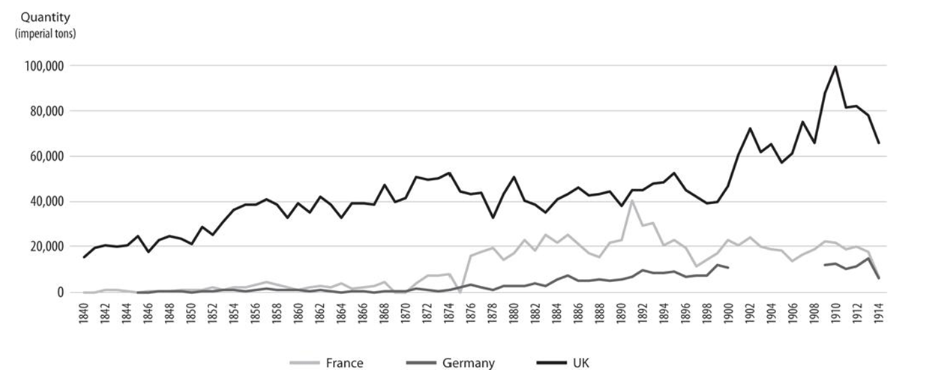
However, Robins notes that by 1914, Britain was re-exporting almost half of the palm oil it imported, and the majority of Germany’s palm oil imports are likely to have been shipped from Britain.28 Given that such a significant proportion of these oil palm commodities was being sold to one of Britain’s imperial rivals, rather than retained for sale to British companies, we have to wonder whether it was really palm oil itself, in its physical or natural form (or, put another way, its use-value), that was prized, or the profits that could be gathered from its sale and the expenses it could reduce.
As Rodney’s point about stearin’s multiple sources indicates, palm oil seems to have served a function that could have been (and had been) served by other types of fat, and was mainly used not because of some special intrinsic properties, but simply because it was cheaper. It was cheaper because of the colonisation of lands where palms could be grown, because it was harvested by hyper-exploited workers, and because of wider ‘market’ factors (e.g. the decline of the whaling industry, labour agitation in the slaughterhouses of Chicago and elsewhere, and the introduction of the steamship and the subsequent fall in freight rates). But as Martin Lynn (who is cited elsewhere in Palm Oil) notes, the palm oil trade entered a protracted “period of problems” after its peak in the 1850s, because:
Indian oils and fats became competitors to African palm oil in Britain [and] existing competitors like Australian tallow significantly improved their position in the market…This increase in supplies of competing oils was matched by a decrease in the demand for palm oil in the British market.29
Focusing particularly on the end-uses of palm oil risks drawing attention away from these market and labour factors, and can also give the impression that the end-uses would not, or could not, have been achieved if it wasn’t for palm oil. In some cases this may have been true, but in others this is doubtful, and the general approach ends up presenting palm oil as a decisive factor in the expansion of imperialism, rather than as a more-or-less profitable effect of that expansion.
Without implying that palm oil has some molecule of evil nesting among its fatty acids, the book does at times give the impression that palm oil isn’t only a profitable commodity for which humans are sacrificed, but is also the sacrificial blade. If the book’s larger goal is to demonstrate that capitalism (as a sacrificial system) is ultimately responsible for the harms unleashed by the palm oil industry, this is actually undermined by the implication that those harms were (and are) specifically linked to palm oil, which seems to suggest that these harms wouldn’t have been inflicted if only the system had found another alternative that was ‘cheaper’ in some intrinsic sense. As the book alludes to elsewhere, ‘cheapness’ is a result of violence and exploitation, not an inherent property of any particular substance, be it palm oil or animal fat. In some of these parts of the book, it could even be argued that palm oil, through an unintended mission-creep in the writing, ends up being treated a bit like a fetishistic stand-in for the capitalist system it’s meant to help us appraise.
At various points, palm oil is described as (emphasis mine): “the secret ingredient and lubricant of the industrial revolution” (p.15), “integral to colonial warfare” (p.16), “one of the essential ingredients of capitalist, imperial modernity” (p.24), “a crucial lubricant for industrial machines, railway locomotives, steamship engines and more” (pp.24-5), “a weapon in the conquest of what Jacques Rancière alludes to as the ‘proletarian night’” (pp.34-5), “soap’s key ingredient [during the colonial era]” (p.47), “essential to the lubrication of industrial machinery, including machines of war” (p.51), “a key component of an even more deadly imperial weapon… dynamite” (p.53), “pivotal to the manufacture of another nineteenth century imperial commodity: canned food”(p.61), “[having] powered the world’s greatest ever migration” (p.90), “provided the kind of commodities that helped entrench racist ideologies of colonialism and bourgeois patriarchy to divide the oppressed of the world against one another” (p.97), and “literally weaponised to help “contain” anti-capitalist counterinsurgency around the world” (p.97). If this list piques your interest, it should. The book presents a fascinating narrative. But it also ends up attributing a lot of decisive causal power to palm oil. In addition to the problems this can present for the book’s overall argument, in several cases the claims seem to run ahead of the sources they refer to.
The book’s treatment of soap (apart from the aforementioned odd claims around Marx, advertising and commodity fetishism) is convincing, and this is a helpful point of contrast with how it tackles other commodities. Britain’s soap consumption doubled between 1801 and 1833, partly thanks to breakthroughs in bleaching and deodorising palm oil for use as its base. Another reason was that the palm oil from which the soap was now made was being mass-produced, under conditions of extreme violence and force, in what is now the Democratic Republic of Congo – particularly on plantations that William Lever had leased from Belgian colonisers (p.37). Haiven notes that many of the advertising campaigns later used to sell soap were explicitly racist, some even showing black children using soap to “wash off” their blackness, and so soap was not just a product of a racist system of capitalist production (on the colonial plantations) but also, through its marketing, a symbolic tool for reinforcing those racial hierarchies. These passages, in the third chapter, are powerful and effective in showing how soap was linked to the plantation system, slavery, and the gender norms that social reproduction depended upon, with palm oil as the uniting factor—not just rhetorically but also factually.
Granted, some of these claims about palm oil can also be made about other sources of fat used in soap production, such as tallow. Take this passage from Nicole Shukin’s Animal Capital:
Animal stock strained from the boilers of rendering plants is converted into glue, glycerin, gelatin, bone meal, soap—seemingly amorphous substances that are in fact deeply implicated in mediating both the material and the symbolic hegemony of cultures of capitalism. The rendering of hides and tallow from California cattle in the 1850s was historically entangled, for instance, in soap’s colonial career as a mass commodity and material signifier marketing a gospel of white supremacy to the so-called dark corners of the globe.30
But the underlying insight about soap can be true in both cases, and the fact that tallow was also used to make soap does not detract from the argument advanced in this part of the book, particularly given the stark connection between soap’s symbolic role in the colonial core and the conditions of repression under which the palm oil in soap was produced.
Unfortunately, though, some of the book’s claims about palm oil’s role in imperial weaponry are more problematic. Returning to the Benin Punitive Expedition, which figures in the book’s narrative as the palm oil industry’s moment of original sin, we read that this expedition was “an early field test of [the machine gun], which cut the Oba’s finest soldiers – and uncounted civilians – to ribbons. The heat and humidity of tropical theatres of imperial warfare meant that lubricants to prevent jamming and preserve military hardware were at a premium.” Furthermore, “Part of the enthusiasm for palm oil might have been the prospect of what might prove to be a philosopher’s stone of late-nineteenth century imperial warfare: a universal gun oil” (pp.51-2).
This passage heavily implies that palm oil was used as a lubricant for guns used by the British Empire’s military to at least some extent. This doesn’t seem to be the case, and the only real reference to gun oil in the cited source for the claim—Priya Satia’s Empire of Guns—is to “sweet oil”.31 Satia doesn’t define what this is, but in the world of lubricants it’s commonly used as a term for olive oil.32 Alternatively, in the fossil fuel industry, “sweet oil” refers to a type of petroleum that’s particularly low in sulphur, and Robins writes that petroleum-derived “mineral oils” started being used to lubricate “fine machinery” from the 1860s onwards,33 so it could also refer to that. The name “sweet oil” doesn’t seem to have been used to refer to palm oil, as far as I can tell. Other common lubricants for fine machinery such as firearms were sperm oil (made from whale blubber) and the tallow (rendered from the fat of pigs or cows) that helped incite the Indian soldiers’ rebellion in 1857. Whether the “philosopher’s stone” comment is taken to imply that palm oil was used as a gun lubricant, or just that incidents such as the soldiers’ rebellion may have made this use an appealing (if never-realised) prospect, no relevant source or evidence is provided to bolster either claim, so it’s hard to tell if this is just another instance of speculation about a possible point of connection between two topics.
Haiven goes on to remark that “while palm oil may never have become the universal gun lubricant of which the Empire dreamed,” it is “almost certain” that it was a key component of dynamite (p.53); he finds it “highly likely” that the inventor of dynamite, Alfred Nobel, would have found palm glycerin “an irresistible choice”. The sources cited by Haiven in support of this claim indicate that nitroglycerine production was indeed, by the end of the 1900s, one of the uses of palm kernel oil;34 and glycerin that was indirectly derived from palm or palm kernel oil was used to make cordite during the First World War.35 But neither of the sources seem to confirm the implied claim that palm oil was Alfred Nobel’s main source of glycerin when he started manufacturing nitroglycerine in the 1860s, or even in the decades that followed. Of course, this isn’t to say that it definitely wasn’t the case: it may well have been. But the sources provided don’t give us reason to believe this is “almost certain” or even “highly likely”. Glycerin can also be made from the rendered fat of butchered animals, and neither the book nor its given sources indicate whether more of it was made from palm oil than from animal fat.
The book also states that napalm – “a weapon that would become the icon of neo-imperialist warfare in the latter half of the twentieth century” – was initially made, “as the name suggests, primarily from palm oil” (p.59). By the time of napalm’s horrific deployment in Southeast Asia, Haiven allows, this was not the case. But then, later on, the book appears to contradict itself: we read that palm oil “was literally weaponised to help ‘contain’ anti-capitalist counterinsurgency around the world” (p.97)—which, absent further illumination from the author, does seem to refer to the use of napalm in the Vietnam War. Moreover, the claim that napalm was ever made from palm oil doesn’t seem to be supported by the source provided—in this case, Robert Neer’s Napalm: An American Biography. According to Neer, Robert Fieser, the Harvard chemist who oversaw the invention of napalm, initially thought that the key ingredient was aluminium palmitate – derived from the oil palm. But (in a stark illustration of palm oil’s exchangeability with other sources of fatty acids, as acknowledged more freely by Robins), this turned out to be based on misleading labelling practices on the part of the lab’s supplier, Metasap Chemical Company. As Fieser would later explain:
The name, coined by me, is derived from ‘Aluminum napthenate-palmitate’ [sic] and actually is a misnomer. Our initial experiments utilised a material marketed under the name aluminium palmitate but, as we later learned, this actually consisted of the soap of the total coconut oil fatty acids of high lauric content… ‘Nalaur’ would have been a more accurate designation.36
As Palm Oil makes clear, the indiscriminate, murderous use of napalm was repugnant in itself, whether or not the substance contained palm oil; and there’s no reason to think this error in the text is anything other than an oversight. Indeed, some of this might seem like nitpicking, but if the material preconditions for imperialism’s military technology are relevant at all – and I agree with the author that they are – then the details of which materials were actually used are important to get right. If the guns used by colonial armies were largely oiled with fats from slaughtered sperm whales, pigs and cows, as opposed to palm oil, then doesn’t this tell us something potentially significant? If the same is true of the glycerin that was used to make nitroglycerin, couldn’t this likewise affect our understanding—and give us another reason to consider the role of animal suffering in the governing world-system’s repertoire of violence?
Haiven’s speculative claims about the significance of palm oil could well be correct, but the repeated use of hedging and heavily-caveated language invites the reader to question the factual basis of his claims, and undermines confidence in the book’s arguments. Its aim of vividly rendering a globe-spanning, centuries-long reality is both admirable and worthwhile, and it attempts to enliven our understanding through a novelistic focus on historical echoes and ironies, and by making inventive connections. But Palm Oil is not a novel—it’s a political intervention, and its arguments are grounded in matters of fact. The repeated concessions to factual uncertainty—the endless ‘maybe’s—are perhaps formally necessary in order to weave such a sublime web. Ultimately, however, they end up giving the unfortunate sense that some of the claims are exaggerated.
In its sketch of palm oil’s totality in the contemporary era, the book focuses either on the consumption end (i.e. palm oil’s end-uses in various consumer products) or on the plantation-based part of the production. It’s an understandable choice of focus: this part of the production process is where the exploitation is most severe, and ultimately it’s the common source that the dizzying variety of end-uses all snake back to. But it does mean that large sections of palm oil’s value chain are excluded from the narrative. As readers, we’re left with gaps in our image of the commodity’s totality – which is inevitable, particularly in such a short book, and isn’t necessarily a problem.
But there’s a more pressing lacuna around the question of what is to be done. The book explicitly concerns itself with ways in which people in the Global North can develop a sense of transnational solidarity beyond the liberal dead-end of consumer boycotts that no plantation worker ever called for:
To the extent we imagine ourselves as merely a consumer, an actor whose agency is limited to the scope of our market participation, we participate in the same cosmological order that demands and normalises [institutionalised human] sacrifice. (p.50)
Given this focus, potential avenues for meaningful solidarity are surely relevant. What can we do? How can we refuse to participate in this cosmological order? But apart from a tentative call for revolution, and what is possibly an indirect reference to degrowth in the call “to radically transform our ways of life and material culture” (p.114), we’re mainly left with questions:
…what would it take to create a world which no longer perceived itself to need industrially produced palm oil? What steps would need to be taken now and in each locale to begin a transition that would reduce and eliminate our dependence on this cheapened substance? What would it mean to consider what kinds of alliances it would take to rebel against those forces of global capitalism that have everything to gain from the perpetuation and expansion of the current order…? (p.115)
Asking what it would ‘mean’ to consider this question is arguably less interesting – and certainly less pressing – than just posing the question directly. What kind of alliances would it take to rebel? That said, if a book only asks a question, it’s not necessarily a shortcoming if it doesn’t provide an answer. And there aren’t any easy answers to this question. In fairness to Haiven, solutions don’t become much clearer when we do look outside of the consumer relationship for points of connection across the North-South divide. For example, almost all palm oil imported to Britain seems to come through two ports, Hull and Purfleet, and the port in Hull accounted for 56.7% of Britain’s palm oil imports in 2012.37 There are only four refineries in Britain, the largest of which are AAK (in Hull) and ADM Pura Foods (in Purfleet). In practice, if most of the palm oil in Britain comes through Hull, most of it is likely to go straight to the AAK refinery next to the King George Dock. And from AAK, it’s possible to anatomise many of the links in the production chain in either direction – back to the plantations38 or on to our supermarket shelves.39
But what’s to be done with this information is not remotely self-evident. Plantation workers haven’t called for a boycott, so even if there is a meaningfully unionised workforce on the docks in Hull (or among the drivers of trucking firms like Abbey Logistics), with a strongly developed sense of international solidarity, a response like that of the East Kilbride factory workers who refused to work on parts that were sold to Pinochet’s air force in Chile in the 1970s may not even be welcomed by its intended beneficiaries. The fate of recent attempts to engage the British trade union movement in a relatedrefusal to facilitate a genocide of the Palestinian people makes the likelihood of solidaristic action around a far less clear-cut issue pretty remote.
If this did occur, and if it was welcomed by the plantation labour force, or if a path like the Just Transition is followed in Indonesia and elsewhere, increased palm oil scarcity would likely result in a higher standard of life and social justice in the Global South. However, it would also entail price rises in the countries at the consumption end—those of us in the Global North. This is the kind of tricky reality that we’d need to confront when responding to a situation described by Haiven as:
…a sublime web, beyond the scope of our individual imaginations, but we have to try because, as the story of palm oil reveals, if we continue to act as if we are not an interconnected, interdependent cooperative species, we will continue to do catastrophic harm to ourselves and to the planet on which we depend. (p.50)
There are no easy answers. Closer links to—and coordinated actions with—plantation workers might be hard to imagine now, but will be wrenched into being. Then again, the type of cooperation we’ll have to undertake in the Global North, for the sake of transnational solidarity with the Global South, might instead look more like cooperative separation. While the type of delinking proposed by Samir Amin in the 1980s has fallen out of favour (largely because of its association with autarky, as Amin himself discussed), imperialism has not disappeared.40 And at least some links in the “sublime web” that it wraps round the world may still need to be severed, if there is to be an escape from it. To follow up on the challenging questions that Palm Oil poses, it could be helpful to further engage with the work of thinkers like Amin and his successors, and with thinkers whose writing and activism directly engaged with the plantation industry and its workers. In 1964 and 1965, for example, the Indonesian Communist Party devoted considerable energy and ink to the ‘agrarian question’ and the links between the plight of rural workers and the ways that the fruits of their labours plugged into international markets.
All this being said, though, Palm Oil: The Grease of Empire is a bracing and consistently engaging book, and is particularly valuable as an introduction to perspectives on palm oil that differ from those of liberal environmentalism. It’s short, and sometimes provocative, but it’s bursting with ideas that are vividly conveyed. It could be read and appreciated by anyone with an open mind and an interest in understanding more about this challenging commodity, and what it can tell us about the system of mystified violence we are all forced – for now, at least – to inhabit.
-
See, for example, Walter Rodney. [1972]. 2018. How Europe Underdeveloped Africa. London: Verso. p.156. “In Britain, the notorious slave-trading port of Liverpool was the first to switch to palm oil early in the 19th century when the trade in slaves became difficult or impossible. This meant that Liverpool firms were no longer exploiting Africa by removing its labour physically to another part of the world. Instead, they were exploiting the labour and raw materials of Africa inside Africa. Throughout the 19th century and right into the colonial era, Liverpool concentrated largely on importing African peasant produce.” ↩
-
In the 1990s, a rainforest logging company paid Shandwick millions of New Zealand dollars to discredit campaigners opposing their operations. See PR Watch Volume 7, number 1 ↩
-
Roland Ennos. 2021. The Wood Age: How One Material Shaped the Whole of Human History. London: HarperCollins Publishers. Chapter 14: Assessing Our Impact, pp.245-64 ↩
-
Chris Miller. 2022. Chip War: The Fight for the World’s Most Critical Technology. New York: Scribner, pp.xxii ↩
-
Jocelyn C. Zuckerman. 2021. Planet Palm: How Palm Oil Ended Up in Everything — and Endangered the World. London: Hurst Publishers. Chapter 5, Silent Summers, pp.109-134 ↩
-
Anne McClintok. 1995. Imperial Leather: Race, Gender and Sexuality in the Colonial Context. London: Routledge, p.210 ↩
-
“Furthermore this brings to completion the fetishism peculiar to bourgeois Political Economy, the fetishism which metamorphoses the social, economic character impressed on things in the process of social production into a natural character stemming from the material nature of those things.” ↩
-
Michael Heinrich. 2004. An Introduction to the Three Volumes of Karl Marx’s Capital. New York: Monthly Review Press, pp.70-9 ↩
-
Heinrich, An Introduction to the Three Volumes of Karl Marx’s Capital, p.73 ↩
-
John Smith. 2016. Imperialism in the Twenty-First Century. New York: Monthly Review Press. Intan Suwandi. 2019. Value Chains: The New Economic Imperialism. New York: Monthly Review Press. ↩
-
This concept is used by Peter Dauvergne to critique what he sees as the dominant forms of environmentalism in the Global North since the 1960s. See Peter Dauvergne. 2018. Environmentalism of the Rich. Cambridge, MA: The MIT Press. ↩
-
Anna Lowenhaupt Tsing. 2004. Friction: An Ethnography of Global Connection. Princeton, New Jersey: Princeton University Press. ↩
-
Tsing, Friction, p.5 ↩
-
Tsing, Friction, p.86 ↩
-
Tsing, Friction, p.240 ↩
-
Søren Mau. 2023. Mute Compulsion: a Marxist Theory of the Economic Power of Capital. London: Verso. p.126 ↩
-
Benjamin Noys. 2000. Georges Bataille: A Critical Introduction. London: Pluto Press, p.107 ↩
-
Jon Greenaway. 2024. Capitalism: A Horror Story. London: Repeater, p.34 ↩
-
Jonathan E. Robins. 2021. Oil Palm: A Global History. Chapel Hill: University of North Carolina Press, p.34 ↩
-
Robins, Oil Palm, p.101 ↩
-
David McNally. Monsters of the Market: Zombies, Vampires and Global Capitalism. Brill: Boston, p.133 ↩
-
Rodney, How Europe Underdeveloped Africa, p.181 ↩
-
Rodney, How Europe Underdeveloped Africa, pp.181-5 ↩
-
A. Olorunfemi. 1982. ‘West Africa and Anglo-German Trade Rivalry 1895-1914’. Journal of the Historical Society of Nigeria, Vol. 11, No. 1/2 (DEC. 1981-JUNE 1982), pp.25-6 ↩
-
Robins, Oil Palm, Chapter 4, ‘Oil Palms and the Industrial Revolution’, pp.75-96 ↩
-
Olorunfemi, ‘West African and Anglo-German Trade Rivalry’, p.26 ↩
-
Olorunfemi, ‘West African and Anglo-German Trade Rivalry’, p.30 ↩
-
Robins, Oil Palm, Graph 4.1, p.80 ↩
-
Martin Lynn. 1997. Commerce and Economic Change in West Africa: The Palm Oil Trade in the Nineteenth Century. Cambridge: Cambridge University Press, pp.116-117 ↩
-
Nicole Shukin. 2009. Animal Capital: Rendering Life in Biopolitical Times. Minneapolis, Minnesota: University of Minnesota Press, pp.74-5 ↩
-
Priya Satia. 2018. Empire of Guns: The Violent Making of the Industrial Revolution. New York: Penguin Press, p.166 ↩
-
S. S. Dara & A. K. Singh. 2004. Chapter 3A: ‘Lubricants’. In: Basics of Engineering Chemistry. India: S. Chand Limited, p.123 ↩
-
Robins, Oil Palm, p.85 ↩
-
Lynn, Commerce and Economic Change in West Africa, p. 118. ↩
-
Zuckerman, Planet Palm, p. 75 ↩
-
Robert M. Neer. 2013. Napalm: An American Biography. Cambridge: Belknap Press of Harvard University Press, p.33 ↩
-
Palm oil has been imported through Hull for at least 100 years, and in 1915 the Olympia Oil and Cake Company refinery on the Humber was the largest in Europe. DEFRA document: ‘Resilience of the food supply to port disruption - Annex 10’. ↩
-
A DEFRA-commissioned report (p.23) speculated that because AAK had a shareholder in common with United Plantations, the British refinery would tend to buy from this supplier, and a United Plantations shareholder document [see ‘Terms of Transaction’ on p. 4] confirms that they supply AAK’s refineries under a longstanding ‘Products Manufacturing and Supply Agreement’. When a food manufacturer such as Mondelez publishes its annual ‘supply chain’ data (which it does to comply with Malaysian and Indonesian sustainability certification schemes, partly introduced to stop this valuable export from being wholly excluded from the EU market), it doesn’t just list the ‘Tier 1 suppliers’ like AAK, but also all the mills from which these suppliers buy their oil. The list for 2019 shows over one thousand specific mills, which will be located either on or close to plantations. In between United Plantations and the AAK refinery in Hull, there are truckers taking the oil to a Malaysian or Indonesian port, then the crew of a ‘liquid bulk tanker’. These tankers can be identified at the King George Dock’s live map, and the Vessel Tracker website can be used to identify which ports they’ve sailed from. ↩
-
Employees at these company docks will oversee the harbour’s arrivals and departures, and supervise the oil getting pumped out of the tankers. Once the palm oil has been processed by staff inside the refineries, it’s taken from those refineries in tanker trucks. For the last few years both AAK and ADM have contracted this task to the trucking company Abbey Logistics, whose employee reviews make grisly reading and whose trucks are parked just a five minute drive from the Hull refinery. So an Abbey Logistics driver will pull round to the refinery, work with the refinery employees to fill up the truck, and take it on to its next destination. My understanding is that they’d then make deliveries to individual manufacturers. If you wanted to track it the rest of the way you’d need to look in the trade press for announcements of their contracts. For example, back when Iceland still used palm oil in their ready meals, it would be delivered to the Gorton facility in Manchester, which is run by Iceland Manufacturing Ltd – an Iceland Foods subsidiary. At Gorton, it would get turned into food products by Iceland Manufacturing’s permanent and temping agency staff, who were subject to mass redundancies after the parent company invested £11 million in new machinery. (In Gorton’s case there’s info about workplace conditions in a published employment tribunal document.) The packaged products will then be taken to regional ‘fulfilment centres’ in Warrington, Enfield, Livingston, Swindon and Deeside, and then onto individual stores by employees of XPO Logistics, the company’s warehousing subcontractor. Like many delivery companies, XPO frequently misclassifies its drivers as non-employees and underpays frontline workers, and has been recently criticised by the Teamsters union for nonetheless paying the CEO “a mega-equity award of over $25 million”. Back in 2018, Unite joined other trade unions throughout the EU in objecting to the company’s union-busting practices, and also drew attention to their severe underpayment of staff at both their Swindon and Warrington centres. The union GMB has also recently criticised XPO for forcing its warehouse staff to work in close proximity throughout the coronavirus pandemic. Unfortunately, the social balance of power is such that criticism from organised labour hasn’t been sufficient to actually change this state of affairs. ↩
-
On this topic, see: Max Ajl. (2021). ‘The hidden legacy of Samir Amin: delinking’s ecological foundation’. Review of African Political Economy, 48:167, pp.82-101 ↩